In this section we will revisit some concepts already discussed in previous Modules, and focus on ways to integrate them in class using digital tools. We will discuss circular economy and waste reduction technologies, water conservation technologies, as well as nature-based solutions (solar & wind power, green buildings etc).
Lesson 2.1 — Circular economy and waste reduction technologies
As mentioned in previous Modules, teaching circular economy and waste reduction technologies is most effective when students can connect concepts to reality. A combination of inquiry, experiments, case studies, and design challenges works well. To make the activities more digital-oriented, you can assign your students a specific concept and digital tool for content creation, ask them to do some online research and data analysis, participate in Citizen Science projects as a class, and use collaborative tools to work together towards a common goal.
Combination project idea: ask students to research the “Reduce, Reuse, Recycle” motto online. Integrate a discussion alongside digital content creation: have the students present the idea behind the motto, the other “Rs”, and discuss possible problems (with recycling systems, for example) and solutions. Then, divide them into smaller teams and ask them to create a digital campaign to mobilize the public to act more sustainably in their everyday life. Let them use any digital tools they prefer: posters, videos, even a quiz game for their peers. Once the content is ready, have each team present. In the end, the class can vote for their favourite presentation via a digital tool like Mentimeter. If you are using Google Classroom or a similar tool on a regular basis, upload their materials.
For a more in-depth look into cross-curricular integration and how to teach sustainability in general, make sure to check Modules 4 and 5!
Depending on the students’ age and knowledge level, as well as the subject you are teaching, you can look more into the circular economy technologies themselves. Some of them include:
- Smart use (Internet of Things sensors, predictive maintenance, smart appliances, remote monitoring, digital product passports)
- Smart design (Computer-Aided Design, Digital Twins, eco-design software, Life Cycle Assessment software, Artificial Intelligence for material optimization, generative design)
- Sustainable manufacturing (3D printing/additive manufacturing, precision manufacturing, robotics, AI quality control, closed-loop manufacturing, water recycling systems)
- Collection technologies (smart waste bins, fill-level sensors, GPS collection routes, RFID waste tracking, QR code product identification)
- Sorting technologies (optical sorting, near-infrared scanners, AI image recognition, magnetic separation, eddy-current separation)
- Recycling (mechanical, chemical, paper, glass, metal, textile, electronic waste)
- Biological technologies (composting, anaerobic digestion, biogas production, vermicomposting, biofertilizers)
- Recovery Technologies (waste-to-energy plants, heat recovery, biomass energy).
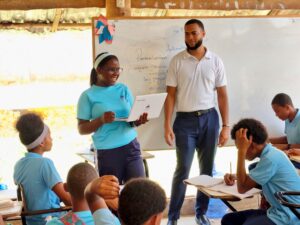
Photo by Joaquin Reyes Ramos from Pexels: https://www.pexels.com/photo/outdoor-classroom-setting-with-teacher-and-students-37476307/
Lesson 2.2 — Water conservation technologies
The availability of clean water is crucial for everyone – people, animals, plants, the planet in its entirety. Water conservation refers to efforts to preserve, save, and manage the use of water efficiently. You can try out some of the following digital tools to explore the topic in the classroom – we have mentioned most of them in the previous sections of this Module:
- Google Earth & Earth Observatory: ask students to investigate bodies of water and compare their changes over time.
- Google My Maps: a Google Maps feature that lets you create your own maps. You can ask students to map your local water sources (rivers, lakes, public fountains, wetlands, etc). In a multidisciplinary approach, they can then design their map (i.e. on Canva) or draw it by hand in an Arts lesson. You can also explore ArcGIS StoryMaps for more interactive options.
Water Footprint Calculator: you can ask each student to calculate their own footprint, or play it as a quiz and calculate the whole classroom’s footprint. There are many digital water calculators, so choose the one you prefer. This activity can lead to many other interdisciplinary discussions, such as dietary habits, math computations, and overall the impact of everyday actions.
For more advanced classes, you can explore some of these technologies:
- Internet of Things (IoT): smart sensors are used to monitor soil moisture and water quality (i.e. in water-efficient crop irrigation)
- Digital Twins: system modeling helps create smart water networks and infrastructure
- Satellite Remote Sensing is used to observe the Earth and monitor drought and reservoir
- Geographic Information Systems (GIS) use spatial analysis for watershed management and water resource mapping
- Drones are used for aerial monitoring, for precision agriculture and reservoir inspection
- Big Data Analytics provide environmental data interpretation, that helps in long-term water resource planning,
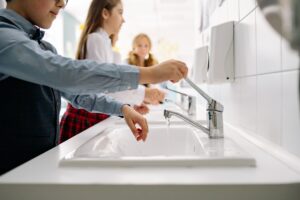
Photo by Yan Krukau from Pexels: https://www.pexels.com/photo/kids-washing-hands-in-the-restroom-8617543/
Lesson 2.3 — Nature-based solutions, green buildings
For many years and well into the 20th century, humans had been using predominantly natural materials to build (i.e. earth, stone, wood, grass). In the late 20th century, though, the building practice had turned to, and started relying heavily upon, industrial materials (i.e. cement, steel, glass). Their environmental cost is huge, and there has been an effort to turn back into natural building practices: not only to use natural materials when building from scratch, but also to upgrade existing buildings with green roofs and green walls.
While discussing this topic in the classroom, you can use the following tools:
- Google Street View: explore cities and buildings around the world and compare: how do they look? What materials were used to build them? Are they in harmony with their surroundings? Are they considered “first-world” or “third-world” buildings? For a multidisciplinary approach, here it would be an excellent chance to discuss the problematic rhetoric around the “third world”, what we consider “modern” and “effective”, and how older techniques and habits can be the solution we are looking for, amidst the climate crisis.
- 3D design: you can use a tool like Energy3D, SketchUp Free, Tinkercard, or Minecraft Education to help students explore building techniques, create virtual buildings and neighbourhoods, and discover sustainable solutions. They can also experiment with virtual building orientation, insulation, window placement, and solar panels.
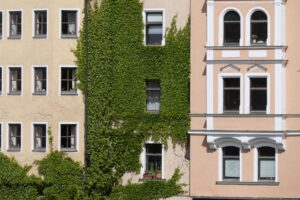
Photo by Michaela St from Pexels: https://www.pexels.com/photo/historic-bavarian-building-facades-in-regensburg-37432236/