
Transformative Pedagogy for a Sustainable Future
As global environmental challenges intensify, the role of education is changing. No longer confined to the mainly transmission of knowledge, education becomes a catalyst for social and ecological transformation. At the center of this evolution lies transformative pedagogy, an approach that reimagines classrooms as dynamic spaces where learners develop the awareness, skills, and values necessary to build a sustainable future. Reimagining the classroom requires more than just adding environmental science to the syllabus, it demands a transformative pedagogy that reshapes how students perceive their role in a sustainable future.
True sustainability education is not about memorizing the dates of climate summits or learning to sort plastics. Transformative pedagogy suggests that the classroom must become a laboratory for systemic thinking. Instead of viewing subjects in isolation, students are encouraged to see the connections between economics, social justice, and ecology.
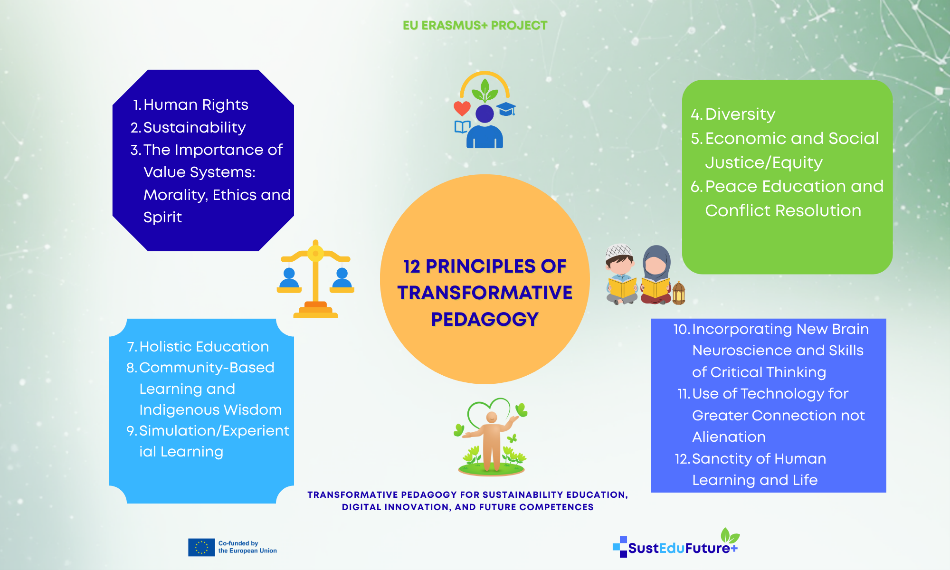
Traditional classroom models often prioritize standardized content, individual performance, and linear instruction. While effective for certain learning outcomes, these methods can fall short in addressing the complexity of sustainability issues. Transformative pedagogy, by contrast, emphasizes critical inquiry, collaboration, and experiential learning. It invites students to engage deeply with real-world problems, encouraging them to question assumptions, reflect on their roles, and envision alternative futures.
In a reimagined classroom, learning becomes an active and engaging process. Students are not just passive recipients of information but through project-based learning, interdisciplinary exploration, and dialogue, they investigate topics such as climate change, resource management, and social justice. These experiences help learners understand the systemic nature of environmental challenges and the need for integrated solutions.
Equally important is the cultivation of values and attitudes that support sustainable living. Transformative classrooms create space for reflection on ethical questions, personal responsibility, and collective wellbeing. Such activities nurture empathy, resilience, and a sense of agency.
The physical and social environment of the classroom also plays a crucial role. Flexible learning spaces, access to outdoor environments, and integration of digital tools can enhance engagement and creativity. Meanwhile, a classroom culture rooted in respect, inclusivity, and open dialogue encourages diverse perspectives and fosters a sense of belonging. Such environments mirror the collaborative and adaptive mindset needed to address global challenges.
However, transitioning to transformative pedagogy requires systemic support. Educators must be equipped with the training and resources to facilitate student centered learning and manage interdisciplinary content. Assessment practices must also evolve, moving beyond standardized testing to include reflective, process oriented evaluation. This is way our project SustEduFuture+ exists, to help with that transition, and to give teachers the support they need.
We truly believe that by embracing transformative pedagogy, classrooms can become powerful incubators for change, spaces where learners are inspired to imagine and create a more sustainable and equitable world.
References:
A. Leicht, J. Heiss, & W. J. Byun (Eds.), Issues and trends in education for sustainable development (pp. 39–59). UNESCO Publishing. https://unesdoc.unesco.org/ark:/48223/pf0000261445
Sterling, S. (2001). Sustainable education: Re-visioning learning and change. Green Books https://www.researchgate.net/publication/289505456_Sustainable_education


